Unmanned Aerial Vehicles on the modern battlefield: from support tools to the foundation of operational awareness
Historically, unmanned aerial vehicles (UAVs) mainly played a supporting role, performing ISR tasks alongside the main command and coordination chain. In the era of multi-domain military operations, this paradigm has become outdated.
The modern operational environment is highly dynamic, dispersed and saturated with technology at a level not seen before. Small unmanned aerial systems, FPV platforms, advanced sensors, Counter-UAS systems and electronic warfare signals generate a volume of operational data that far exceeds the analytical capacity of field teams.
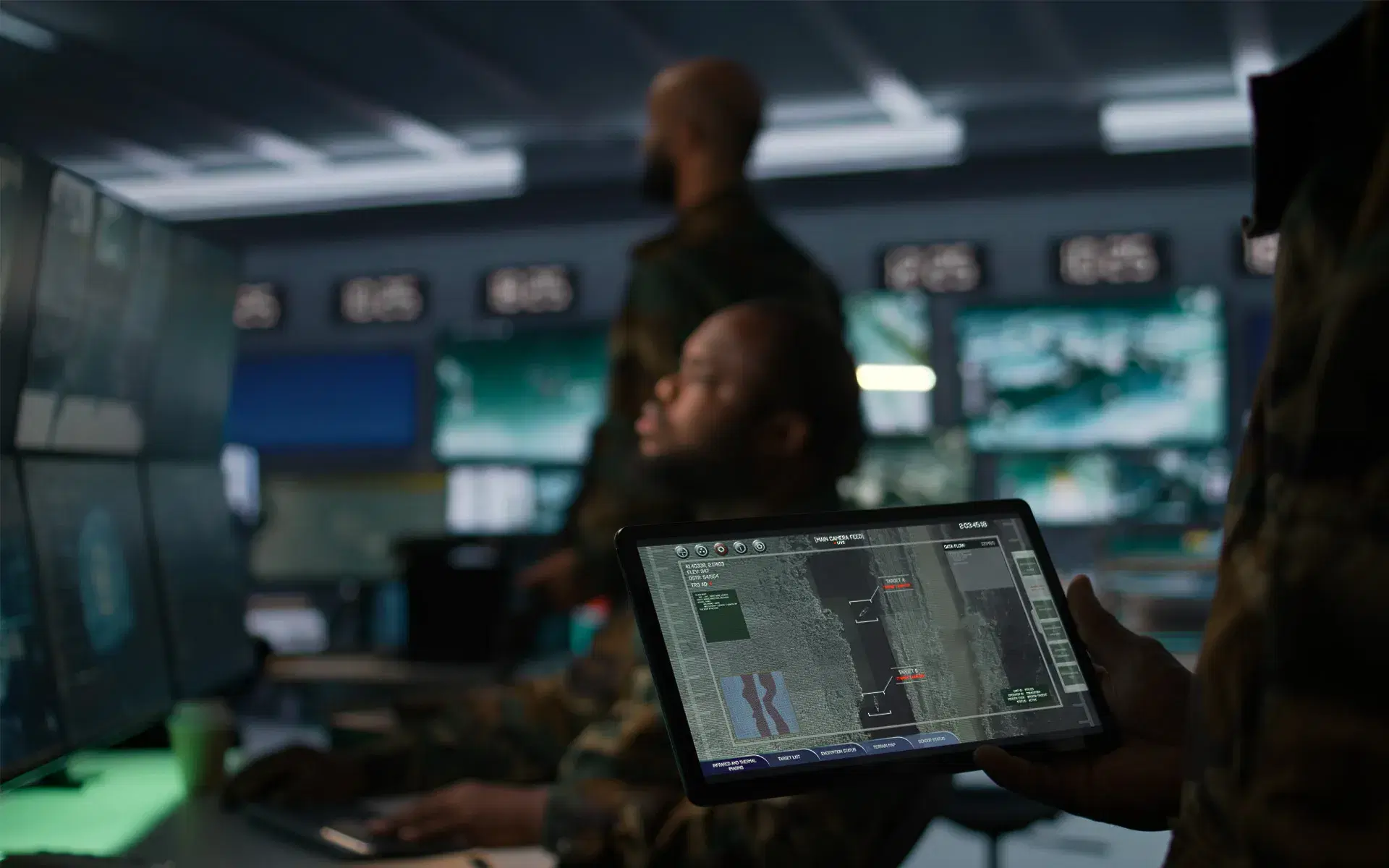
In these conditions, UAVs are no longer peripheral tools. They have become one of the fundamental vectors of tactical situational awareness. Their value no longer comes only from observation, but from the ability to integrate drone-derived data into a broader ecosystem of command, communication and operational coordination.
Shortening the Sensor-to-Shooter chain
The main technological challenge is no longer the acquisition of visual data itself, but its rapid, secure and reliable conversion into tactical decisions.
A video stream that remains isolated at the level of a single ground control station has limited operational value. An object detection that is not immediately shared across a network-centric operational environment represents a missed tactical opportunity.
Modern operations require the integration of telemetry, live video, AI-assisted analysis and field reports into a Common Operational Picture. This means creating a coherent information environment in which commanders and soldiers in the field gain immediate understanding of the operational situation and the ability to coordinate action.
This is the direction in which systems such as TROP by Defencebay are being developed. They treat drones, sensors, video, maps, communication and tasking not as separate tools, but as elements of one operational layer. The objective is not only to display data on a screen, but to transform it into objects, alerts, markers and tasks that can be used immediately in the field.
Operating in disconnected and degraded environments
The need for full integration becomes critical under advanced electronic warfare conditions and in environments with disconnected, intermittent or low-bandwidth communications, often referred to as DIL or DDIL environments.
On the modern battlefield, stable access to GSM networks, satellite communications or the internet cannot be assumed. In the face of jamming, network overload and fragmented connectivity, command systems must provide autonomy, resilience and the ability to prioritise data transfer.
The critical value lies in the transmission of essential data: coordinates, alerts, short formatted reports, friendly positions, orders and detection vectors. When continuous video transmission is impossible, the highest operational value often comes from the result of image analysis itself — for example, a geolocated target marker, an object detection alert or an updated flight route.
This is why TROP-class architectures are designed around an offline-first approach and operation in degraded communication conditions. Video remains important, but it does not always have to be transmitted first. In practice, the ability to deliver a lightweight, structured operational message may be more valuable, especially when the network does not allow full multimedia transfer.
Edge AI in tactical operations
In this context, artificial intelligence becomes strictly utilitarian. Its role in tactical operations is to radically shorten the OODA loop: observe, orient, decide and act.
Image analysis algorithms running at the edge can automatically classify an object and estimate its coordinates, turning raw sensor data into a shared operational object enriched with a confidence score. This automation reduces the need for manual description by the operator and generates structured data packages that can be immediately used by other actors in the field.
In practice, this means moving from passive viewing to active use of data. The system does not simply display drone footage. It helps answer key operational questions: what has been detected, where it is located, how confident the detection is, who should receive the information and what response should be triggered.
This direction is particularly important for platforms such as TROP, where AI, drone data, map context and the Common Operational Picture are designed to operate as one process. Detection should not end on the operator’s screen. It should become part of coordination.
Multi-layer data fusion and Counter-UAS
The same principles apply to the Counter-UAS domain. Friendly UAVs, unidentified objects, tactical radar data, RF detection, electro-optical and infrared systems, acoustic sensors and operator reports must be fused within one command architecture.
Without such integration, the result is information chaos, delayed response and serious problems with airspace deconfliction. In a drone-saturated environment, it is not enough to detect an object. It must also be classified, linked to situational context and rapidly shared with the right users.
For this reason, next-generation operational systems should be ready to integrate both friendly drone data and Counter-UAS sensor feeds. In this model, the field platform can act as a shared operational surface for tracks, alerts, threat zones, detections and tasks. TROP fits into this logic as a layer that can connect drone, sensor and warning-system data with maps, communication and decision-making workflows.
The evolution of C4ISR systems
These changes require a redefinition of how battle management systems and C4ISR platforms are designed. Modern military software architecture cannot be just a digital map. It must become an operational layer connecting users, missions, sensors, communications, video and decision-making processes.
It must support hardware-agnostic operation and remain usable across low-bandwidth networks. It must enable interoperability with existing ecosystems, including formats and protocols used by TAK/CoT users. It must also ensure data sovereignty and give organisations full control over the deployment model — from cloud and edge environments to on-premise and air-gapped installations.
TROP is an example of this approach: not as a monolithic replacement for every command system, but as a tactical operational layer that can complement existing structures. Its value increases especially where teams need a shared operational picture, resilient communication, drone and sensor integration, and the ability to operate under limited connectivity.
Summary
Unmanned aerial vehicles are now an integral component of advanced command systems. Although they radically extend the range of observation and shorten target detection time, their full potential is unlocked only when they are connected to a Common Operational Picture, supported by AI analytics and integrated with targeting and decision-making processes.
In an environment dominated by sensors, growing autonomy and electromagnetic disruption, forces that treat drones as isolated tools will only aggregate excessive amounts of data without turning it into better decisions.
Operational dominance will belong to those who can seamlessly transform information streams from UAVs into integrated situational awareness — and then turn that awareness into anticipatory, coordinated tactical action.
In this sense, the future of drones on the battlefield does not depend only on their range, payload or autonomy. It depends on how effectively they are integrated into one resilient, interoperable and AI-supported operational ecosystem.