The growing number of uncrewed aerial systems is changing how military units, critical infrastructure, borders, ports and airports must be protected. Drones have become widely accessible tools for surveillance, reconnaissance and transport, but they can also be used to disrupt operations, conduct unauthorised observation, deliver payloads or carry out direct attacks.
Counter-UAS systems are being developed in response to these threats. The discussion around them, however, often focuses on the final and most visible stage of the process: jamming, intercepting or physically destroying the drone.
Defeat remains important, but it does not create a complete counter-drone capability on its own.
Before a response can be taken, the object must be detected, located, tracked and correctly classified. Information from several sensors must be combined, and the operator must receive enough context to determine whether the observed platform actually represents a threat.
Modern Counter-UAS should therefore not be viewed as a single device. It is a broader process connecting sensors, command systems, communications, procedures, operators and available response options.
Defeat is the end of the chain
The effectiveness of a Counter-UAS system cannot be measured only by its ability to jam or destroy a drone.
Detecting an object does not explain what it is. Classifying it as an uncrewed aircraft does not automatically mean it is hostile. An available effector also has limited value if the operator cannot identify the correct target, assess its behaviour or understand the consequences of the proposed action.
A complete Counter-UAS capability begins much earlier. The object must first be detected, located and maintained as a stable track. Information from different sources must then be correlated, its reliability assessed and the status of the platform established. Only then can an informed decision be made.
This approach is increasingly visible across NATO and European defence programmes. Emerging architectures do not focus solely on effectors. They connect radar, radio-frequency sensing, electro-optical systems, command-and-control platforms and decision-support tools.
Counter-UAS should therefore not answer only one question: how do we stop the drone?
It must first answer: what is operating in the airspace, how is it behaving, what risk does it represent and which response is appropriate?
Detection does not equal understanding
The same airspace may contain drones operated by friendly teams, platforms belonging to other services, civilian aircraft performing legitimate tasks, unidentified objects, autonomous systems and hostile platforms.
In this environment, a single alert from a radar, camera or RF sensor does not provide situational awareness. It only shows that one sensor has registered an event.
To become operationally useful, the alert must be placed in context. The operator needs to understand where the object is located, how fast it is moving, which sensors are observing it and whether the track remains stable. It is equally important to know whether the platform corresponds to an approved mission, whether it remains inside its designated corridor and which units or protected assets are located along its projected route.
Only when this information is combined can a technical signal become an operational object that can be properly assessed.
That is the fundamental difference between detection and situational awareness.
No single sensor can provide the complete picture
Every sensor type has its own strengths and limitations.
Radar can detect objects regardless of whether they emit a radio signal, but small drones may be difficult to distinguish from birds or background clutter. RF sensors can identify communication between an operator and a platform, yet they are less effective against autonomous systems, aircraft using unexpected frequencies or wire-guided drones.
Daylight and thermal cameras can visually confirm an object, but their effectiveness depends on weather, visibility, distance and the ability to point the sensor towards the correct area. Acoustic systems can add another layer of detection, although wind, background noise and urban environments may reduce their performance.
None of these technologies provides a complete answer on its own.
The greatest value appears when information from different sources is correlated. When a radar detects an object, an RF sensor identifies a transmission and a camera acquires an image of the same platform, the operator should not receive three separate alarms.
The system should recognise that the observations refer to one object, combine them into a coherent track and preserve information about data provenance and classification confidence.
This is true data fusion. It is not about displaying several panels next to each other. It is about creating one shared operational picture.
Identifying friendly drones is becoming as important as detecting hostile ones
As more uncrewed systems are deployed by friendly teams, the risk of misidentification increases.
The issue can no longer be reduced to a simple friendly-or-hostile distinction. A drone may be operating according to an approved mission, leave its assigned corridor because of interference, lose connectivity or behave differently from the original plan.
Its status must therefore remain dynamic. It may evolve from unidentified to probably friendly, and eventually to a confirmed threat as new information becomes available.
Technical signatures and visual imagery are not enough. The system also needs mission context, including the expected route, operating time, operator position, available telemetry and data from other command systems.
A drone operating in the correct area is not automatically friendly. At the same time, a friendly platform that leaves its assigned zone because of a technical failure should not be declared hostile without further assessment.
Operators should also understand why the system assigned a particular status. A classification without explanation can create a dangerous sense of certainty.
The C2 layer turns individual technologies into an operational capability
Individual Counter-UAS components can perform correctly in isolation while the overall architecture remains ineffective.
A radar may detect an object, a camera may confirm its type and an effector may be ready to respond. Yet if data cannot move between these elements, the operator must still reconstruct the situation manually across several separate interfaces.
This creates delays, interpretation errors and decisions based on incomplete or outdated information.
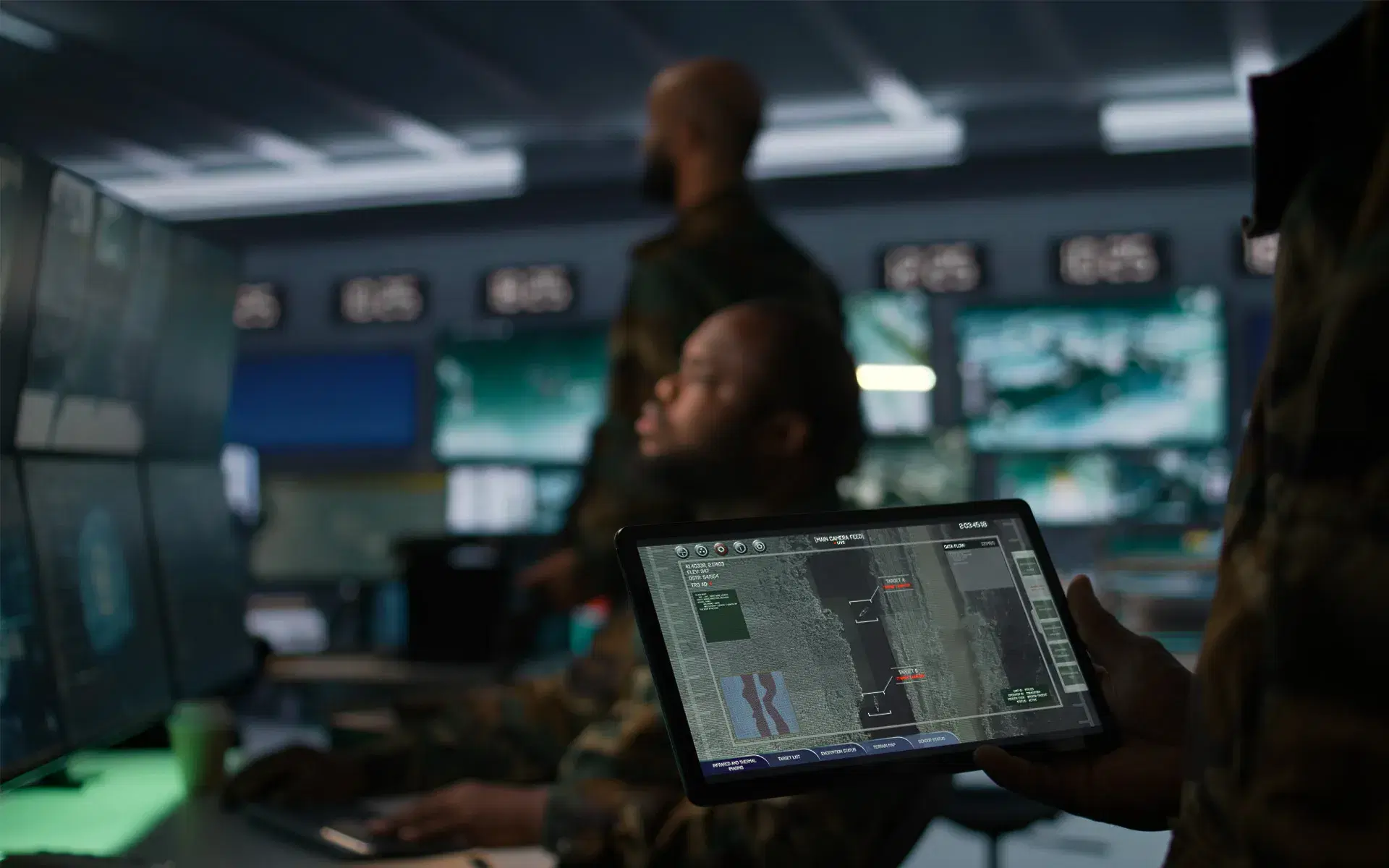
The command-and-control layer is therefore becoming one of the most important elements of Counter-UAS. Its role extends far beyond visualisation. It should combine radar tracks, RF observations, EO/IR imagery, friendly-force positions, active drone missions and available response options.
Instead of switching between multiple screens, the operator receives one picture in which technical data is connected with operational context.
The C2 layer should also support escalation to the appropriate level of command, coordination between several teams and documentation of decisions and actions.
It is the component that turns separate devices into a coherent operational capability.
AI should reduce uncertainty, not replace human judgement
As more sensors are deployed, the amount of information requiring analysis continues to increase. AI can support object detection, platform classification, behaviour analysis and the correlation of tracks from multiple sources.
It can also prioritise alerts and direct the operator’s attention towards events that deviate from expected patterns.
AI does not, however, eliminate uncertainty.
A model may perform less reliably in unfamiliar weather, against a modified platform or in a situation not represented in its training data. Operators should therefore see not only the classification result, but also the confidence level, supporting data sources and time of the latest update.
The most important decisions should remain under human control.
The purpose of AI is to shorten the time required to understand the situation, not to produce automated assessments that cannot be challenged or verified.
Not every drone requires defeat
The correct response to a detected drone is not always the immediate use of an effector.
In some situations, continued observation or cueing an additional sensor may be sufficient. In others, personnel may need to be warned, friendly platforms redirected, a protected facility secured or the incident escalated to a higher command level.
Only after the threat has been assessed should a non-kinetic or kinetic countermeasure be considered.
The correct response depends on the environment. Protecting a military unit during conflict is different from protecting an airport, port, industrial facility or public event.
In civilian settings, particular attention must be given to public safety, legitimate airspace users and the risk of disrupting communications systems.
An effective Counter-UAS system should therefore support a proportionate response rather than automatically driving escalation.
Resilient communications are part of the Counter-UAS system
An integrated counter-drone architecture depends on information exchange. When sensors, command posts and field teams lose connectivity, the shared picture can quickly stop reflecting reality.
The problem is not limited to complete network loss. Low bandwidth, high latency, radio interference, infrastructure congestion and the loss of individual nodes may all reduce operational effectiveness.
Counter-UAS systems should therefore be designed for degraded conditions. Local processing, data buffering, Store-and-Forward and delayed synchronisation can help preserve continuity when connectivity becomes unstable.
Information should also be prioritised.
An object’s position, movement direction and a warning to a nearby team may require immediate transmission. A full video feed can be delivered later when sufficient bandwidth becomes available.
Communication resilience is not an optional addition to Counter-UAS. It is a prerequisite for maintaining the operational picture and continuity of decision-making.
Interoperability determines whether the system can scale
Most organisations do not build their Counter-UAS capability from a blank sheet. They already operate radars, cameras, radio networks, uncrewed platforms, servers and command systems.
New technologies must therefore work within the existing environment.
When every sensor and effector relies on a closed interface, the organisation becomes dependent on one vendor or on expensive bespoke integration. This slows development and makes it difficult to introduce new technologies.
Interoperability must extend beyond the technical transfer of data. Information about its source, age, confidence and object status must also be preserved.
Only then can solutions from different manufacturers genuinely operate as one system.
The best sensor inside a closed environment may provide less operational value than a slightly less capable solution whose data is immediately available across the command structure.
The complete capability must be tested
A Counter-UAS test should not end when a radar detects a drone or an effector stops it.
The more important question is whether the organisation understood the event correctly. Position accuracy, track stability, false-alarm rates and identification quality must all be assessed. It is also necessary to determine whether information reached the correct decision-maker, how long the decision took and whether the system continued to function under interference.
Post-response assessment is equally important. Operators need to know whether the action was effective, whether the threat was actually removed and whether additional objects have entered the airspace.
The drone threat evolves faster than traditional procurement cycles. New control methods, flight profiles and platforms resistant to existing countermeasures continue to emerge.
Counter-UAS cannot therefore be validated once and considered complete. It requires recurring testing under conditions that reflect the operational environment.
The central question is not whether a device detected and stopped a drone.
It is whether the organisation was able to detect the event, understand it correctly and take the appropriate action.
TROP’s role in a Counter-UAS architecture
TROP does not replace specialised radars, RF sensors, cameras or defeat systems.
Its role can be to connect data from these components and present it within one shared operational picture.
In a Counter-UAS architecture, TROP can combine detected objects with information about friendly drones, mission plans, flight corridors, operator positions and field teams. Sensor data can be displayed alongside video, protected zones and information from external C2 systems.
As a result, the operator receives more than a notification that an object has been detected.
They can see where the platform is located, how it is moving, which sensors are observing it and whether its presence corresponds to an approved mission. They can also understand which friendly units are nearby and how the event has developed over time.
TROP can support information exchange between operators, field teams and command posts. TAK/CoT interoperability and deployment across edge, on-premise and isolated environments allow the platform to operate as part of a wider architecture rather than as another closed technological island.
The objective is not to place the greatest possible amount of data on a map.
It is to deliver the right information to the right person before the time available for a decision expires.
Effectiveness begins before defeat
Defeat remains an important element of Counter-UAS, but it is only one stage of a much broader process.
Without reliable detection, stable tracking, identification, data fusion and effective command and control, even an advanced effector may be used too late, against the wrong object or in a way that is disproportionate to the situation.
A mature counter-drone capability connects technology, data, people, procedures and communications within one system. It helps distinguish friendly platforms from potential threats, reduces operator overload and maintains a shared picture under difficult communications conditions.
The most important component of a Counter-UAS system is not always the one that physically stops the drone.
Sometimes, it is the layer that allows operators to understand what is happening in the operational environment before an irreversible decision is made.