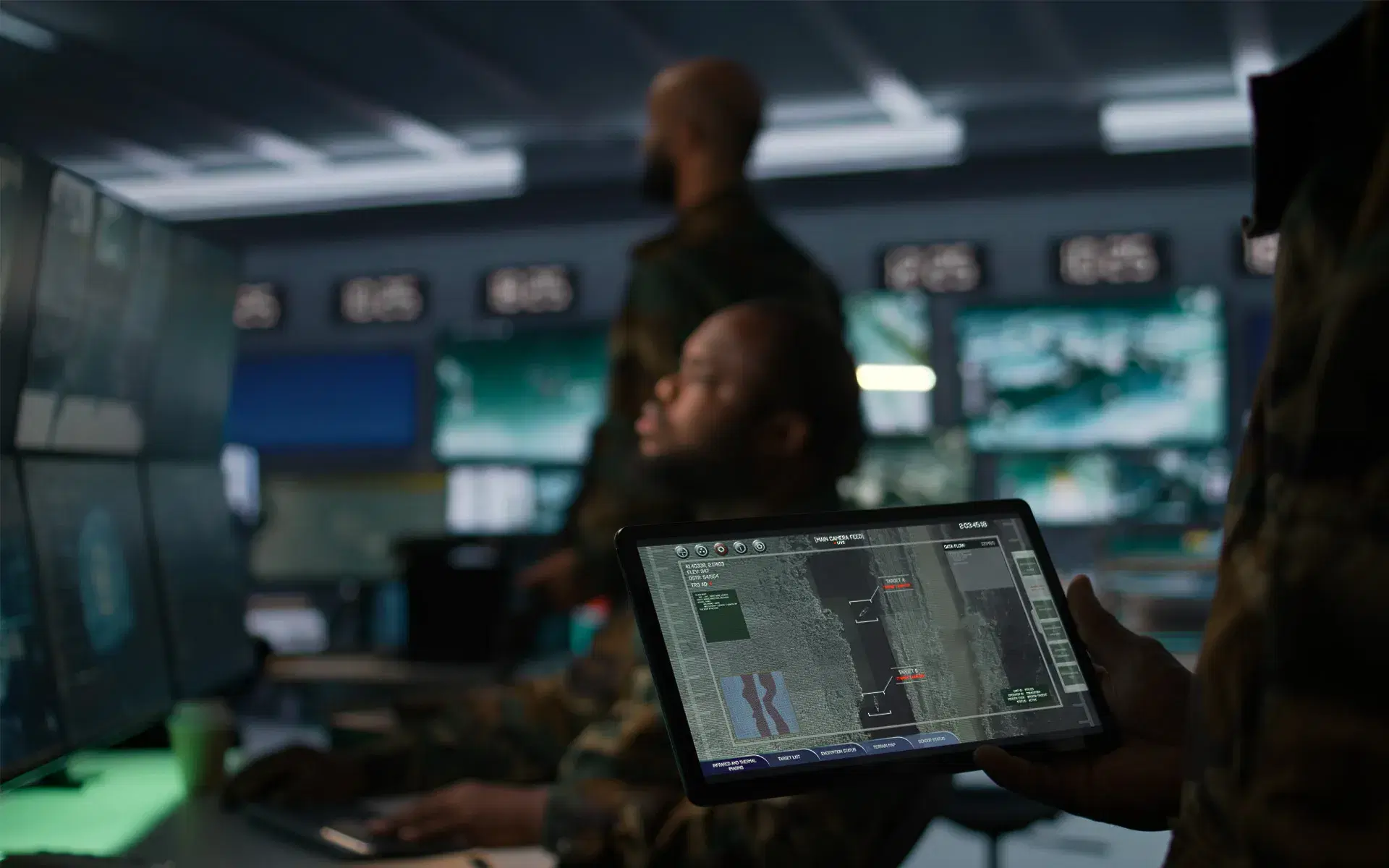
Information superiority. Make decisions faster than the adversary.
TROP delivers tactical advantage through interoperability and enhanced survivability in distributed operations. The system maintains a Common Operational Picture (COP), shortens the OODA decision cycle, and ensures continuity of operations in electronic threat environments - including under degraded communications and in autonomous mode. TROP ensures:
- Elimination of information chaos.
- Reduced reaction time.
- Certainty of friendly force location and full operational situational awareness.
- On-premise/air-gap and EU/PL cloud deployment - in full compliance with unit security requirements.
Territorial Defense and Patrol Operations
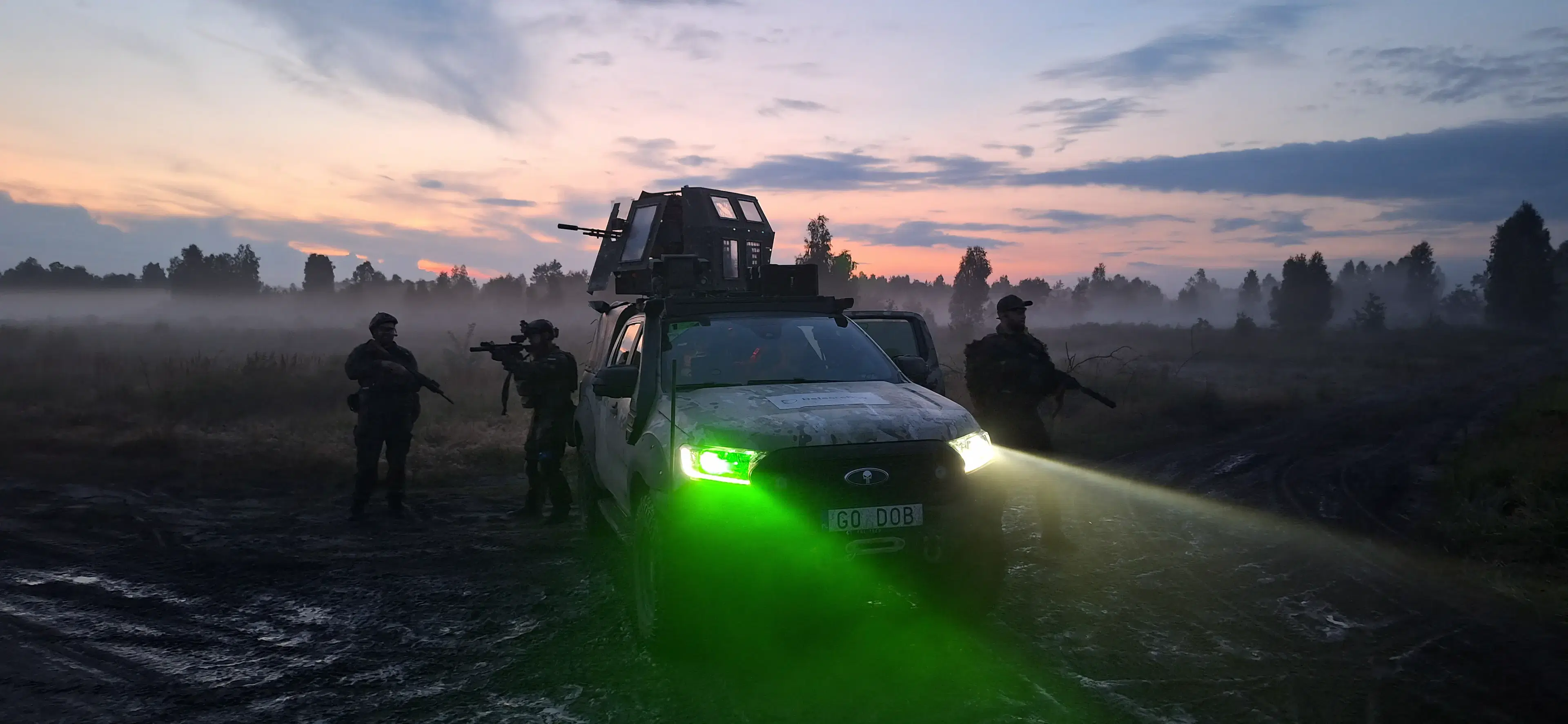
Users: Territorial Defense Forces, Border Guard, units operating in distributed environments.
Operational context: Activities outside telecommunications infrastructure or in electronic threat environments.
Solution architecture:
- Mobile nodes mounted on vehicles function as moving mesh network hubs, extending operational coverage
- External antennas increase effective range
- Network traffic secured with AES-256 encryption and channel-assigned keys - controlled access for user groups
Key Capabilities of the TROP System
TROP has been designed to support users in making rapid decisions, maintaining operational continuity, and securely exchanging information even under conditions of disruption, limited connectivity, or offline operation. The system combines a shared operational picture, a resilient communication architecture, advanced security mechanisms, and integration with multiple data sources, thereby strengthening coordination at every level. In practice, this results in improved situational awareness, faster response times, and greater operational resilience for teams operating in the field.
Common Operational Picture (COP) for All Levels of Operation
A single, consistent operational map with synchronized markers, positions, and events ensures that all participants share the same up-to-date picture of the situation-from field operators to command centers.Security Designed from the Ground Up
The system architecture has been built according to the security-by-design principle and includes operation in isolated environments, mTLS authentication, key protection in TPM/Secure Enclave, and AES-256 class encryption.Autonomous Operation and Air-Gapped Environment Support
TROP maintains full functionality even without Internet access, enabling offline operation, separation of operational domains, and continuity of operations in environments with limited or disrupted infrastructure.Advanced Access Control and Full Auditability
The system enables granular user permission management, strict enforcement of access policies, and comprehensive event logging, supporting information security and operational accountability.Mission Data Protection and Secure End-to-End Communication
Operational data remains fully under the organization's control, with access restricted to authorized roles and channels. End-to-end encryption, key rotation, and mission data isolation increase system resilience against unauthorized access.Scalable Multi-Level and Federated Architecture
TROP is designed to operate within multi-level structures-from a single team to distributed command organizations-with the ability to connect multiple information enclaves and build a federated server architecture.Universal Communications Platform with Transmission Redundancy
The system integrates multiple communication media, including DMR, 5G, SAT, and MESH, enabling multi-path, disruption-resistant connectivity and maintaining data exchange even in contested environments.Ready for Integration with UAV/UGV and Sensor Sources
Built-in APIs and a multimedia server enable native support for video streams and data from unmanned platforms and other sensors, accelerating information distribution and strengthening situational awareness.Multi-Platform Operation, Interoperability, and Full Technological Control
A consistent working environment across Android, iOS, and web browsers, a proprietary backend without dependence on closed solutions, and compliance with MIL-STD-2525 and Cursor on Target (CoT) ensure deployment flexibility, interoperability, and full control over system development.
Why TROP
TROP is not just another mapping tool. It is a platform integrating mission participants, organizational roles, communication, and data into a single cohesive operational picture. The system accelerates the OODA decision cycle, minimizes the risk of human error, and enables coordination of distributed operations - including in conditions of unstable connectivity or active electronic jamming.
Operational Use Case Scenarios
| Topic | Challenge | TROP Solution |
|---|---|---|
| Blue Force Tracking (BFT) - Friendly Force Location | Risk of fratricide and difficulty coordinating distributed elements. | Automatic real-time position tracking. The commander has a full picture of subunit deployment regardless of direct line-of-sight conditions. |
| Close Air Support (CAS) | Time-consuming coordinate transmission via voice communication and risk of errors in the 9-line format. | Digital target designation. The JTAC marks an object/area on a mobile device, and the system automatically shares the data with other participants. The click-to-target function reduces reaction time from minutes to seconds. |
| Integration with Unmanned Aerial Systems (UAS) | The UAS operator has situational awareness, while the rest of the team must rely on verbal descriptions. | Video Downlink - direct transmission of the video stream from the unmanned platform to team members’ devices. Situational awareness before maneuver execution. |
| Navigation in GNSS-denied environments | Jamming of satellite navigation signals by the adversary. | Offline maps integrated with inertial navigation - maintaining terrain orientation under complete GNSS degradation. |
Capability gap in the mechanized infantry segment
Problem: Advanced C2 systems primarily operate on wheeled/tracked platforms and at command posts.
Operational gap: Infantry soldiers outside vehicles often have only voice communication available.
Consequences: Informal use of commercial solutions on private devices to maintain situational awareness during exercises and operations.
Conclusion: An operational layer is required that combines security, interoperability, and accessibility for the field user.